
Aliveness Stories / The beginning
Why I’m building Alive Together
Why I want to bring people together, and what I hope we can create through Alive Together.
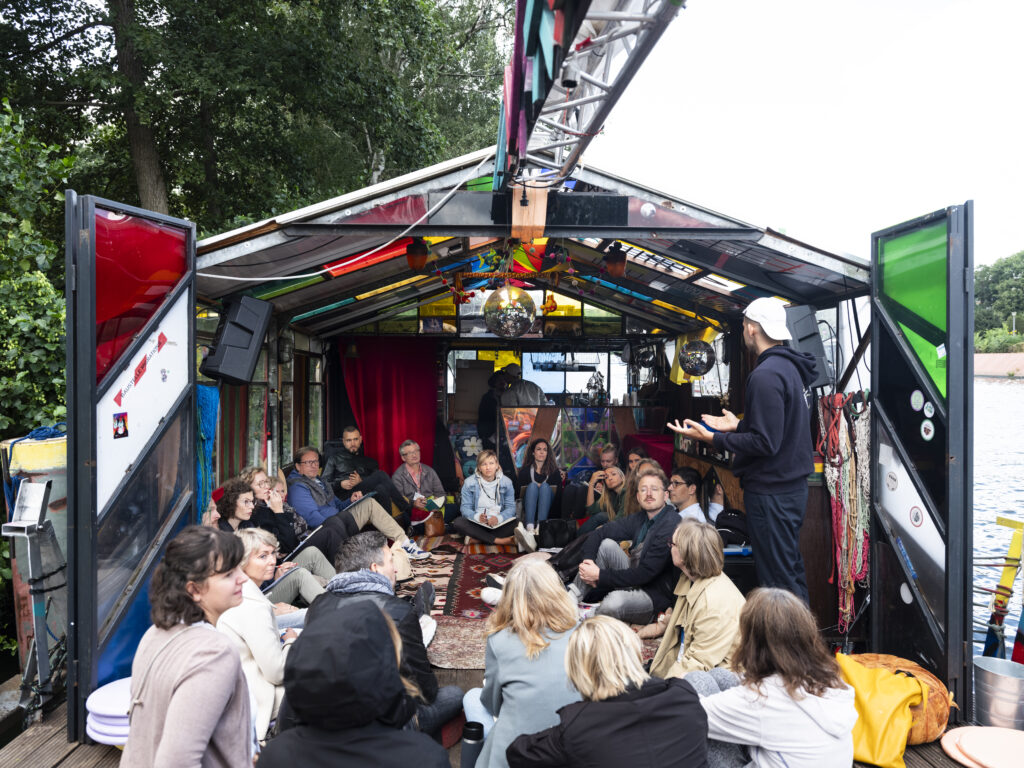
When did someone last really listen to you for ten minutes?
I mean someone who was interested in what was on your mind and gave you time for an answer that only began to take shape as you spoke. Perhaps it was a decision, a worry, or something wonderful you finally wanted to share with someone.
These are the moments I want Alive Together to make possible more often, for people who take responsibility and want to create something meaningful for themselves and others. I believe we need to make time to come together regularly.
Connection needs a place in everyday life
We can work, shop, learn and find entertainment from home. I value that freedom. At the same time, one question stays with me: where do we meet people when fewer encounters happen along the way?
An analysis of American time-use data from 2003 to 2023 describes a long-term decline in activities outside the home. The pandemic accelerated this change, with only a limited recovery by 2023. This is a US finding, and it measures how people spend their time, not the quality of their relationships. But it helps us see how opportunities to connect can change. Morris, Speroni and Taylor, policy brief, March 2025.
I want to make room for connection in everyday life by inviting people to meet regularly and helping them get to know one another.
In 2025, the WHO reported that approximately one in six people worldwide experiences loneliness. WHO Commission on Social Connection.
The importance of social relationships for health is also well documented. A meta-analysis of 148 studies involving more than 300,000 participants found an association between stronger social relationships and higher odds of survival over the respective observation periods. This does not establish a health effect from any particular community, but it shows how seriously we should take the subject. Holt-Lunstad, Smith and Layton, 2010.
Being able to tell someone what is happening in my life, laugh together and ask for help matters to me. I want to be there for others too.
For people who take responsibility
I’m building Alive Together for entrepreneurs, independent professionals and creators who want meaningful work, stronger relationships and a community that supports their well-being. I want us to have people around us who help us grow while making room for rest and a life we enjoy. What matters to me is that outlook, whatever someone’s job title.
People who make a lot happen can also carry a lot alone. I want them to have a place where they can voice their questions and think through the next step together. There should be room for joy too.
My hope is that these experiences travel further: into a team meeting, a conversation at home, or an encounter with someone who needs support.
We can practise this in our conversations by asking a little more before giving advice and listening to the answer. We can also say what we need while allowing others their own perspective.
A series of five experiments with a total of 1,643 participants offers a relevant finding: high-quality listening reduced momentary loneliness after people shared earlier experiences of rejection. Some experiments involved actual conversations, others imagined situations. The finding concerns this specific experience, not a lasting treatment for loneliness. Itzchakov and colleagues, 2023, published online in 2022.
For the way we design our gatherings, this means that the quality of our attention deserves deliberate care. We need clear conversation agreements, attentive hosts and the freedom to decide what we share. People should be able to get to know each other at their own pace.
Why this work matters to me personally
I grew up in a village. Community was part of everyday life. At fifteen, I became a basketball coach. For sixteen years, bringing people together, supporting their development and building a team was part of my life.
Later came my studies in business psychology and experience working with leadership trainers. For ten years, I have been building communities and creating encounters online and in person. I have hosted more than five hundred masterminds.
Bali during the pandemic and the Burning Man community also shaped me. I experienced how much aliveness emerges when people create something together: a meal, a game, a conversation, a wild idea, an evening they remember for years.
All of this has made me want to pass that experience on and help others become thoughtful hosts themselves.
A simple rhythm for real connection
The rhythm we want to build consists of monthly online masterminds and weekly Aliveness Walks.
In the format we are developing, four people would connect by audio for forty-five minutes. Each person walks wherever they are; anyone who wants or needs to sit can take part too. Each person would have ten minutes of full attention. After all four have spoken, there would be five minutes to close together. A clear structure gives everyone space.
Movement has value in its own right. In four experiments, walking helped people generate a wider range of ideas. The benefit did not apply equally to tasks with a single correct answer. This is an interesting foundation for our format, whose own effects we still need to understand. Oppezzo and Schwartz, 2014.
In the masterminds, we want to look at challenges together, share perspectives and develop concrete next steps. Successes and joy belong here just as much as open questions. Personal conversations remain free from sales interruptions.
A living network takes many forms
People outside our closest circle can enrich our lives too. Sandstrom and Dunn found associations between interactions with acquaintances, wellbeing and a sense of belonging. Their 2014 study.
There is also experimental evidence concerning professional opportunities: large randomised LinkedIn experiments showed that weaker ties can support job mobility. The relationship depended on the strength of the connection and the professional context. This does not establish a rule for every opportunity in life. Rajkumar and colleagues, 2022.
The familiar Dunbar’s number of around 150 is often described as a natural limit to our networks. The scientific basis for deriving a precise number is disputed. Nobody needs to reach a particular number of contacts in Alive Together. Lindenfors, Wartel and Lind, 2021.
What matters to me is an environment where people can meet and relationships can grow. Some become close. Others remain brief, friendly encounters. Both have a place.
My vision is ten thousand people who pursue their ambitions while caring for their health and relationships, and who bring that care into their own circles.
To help this grow, I want to train hosts for online gatherings, and later for local groups and chapters. We are building this step by step and want to understand what actually helps people return, contribute and experience connection.
Companies can help fund the facilitation and organisation, or contribute relevant products and services. I also want the people behind the brands to participate themselves and share their experience.
If you would like to help shape these gatherings, I invite you to join us.